Discover
Begin with recognizable speakers, podcasts, and interests instead of an explanation of the whole system.
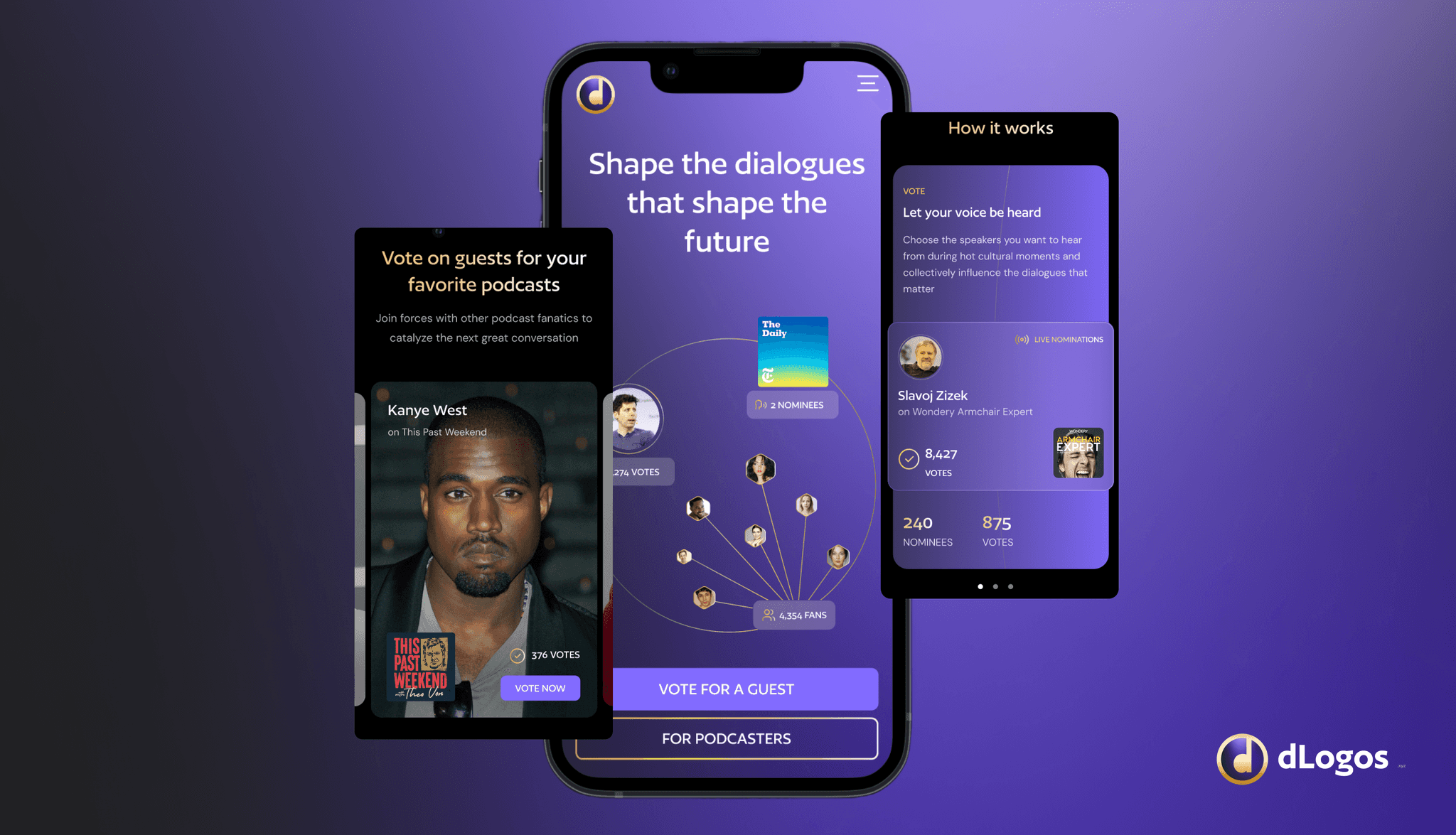
Episode Builder onboarding integrated into the website
Product Designer + GTM Strategist
Rapid founder–designer loops with Brian, Ankit, and the wider team
Website and product UX, host onboarding, design-system work, Podcast Champions, outreach, and content frameworks
dLogos could easily be understood as a podcast discovery or guest-voting tool. Voting was only meant to be the beginning: listeners could influence who appeared, what was asked, and which conversations gained momentum.
What I noticedHosts understood how to vote. The harder question was why the vote mattered afterward.
Early conversations often returned to the mechanics of voting: how a host would share it, what happened when someone won, and whether a vote guaranteed a guest appearance. People understood the immediate action, but not what their participation was building toward. The most concrete part of the experience was defining their perception of the entire product.
Onboarding and the Episode Builder evolved in parallel. The hypothesis was that familiar choices could bring people in, while each next action gradually revealed a deeper role in shaping a conversation. The goal shifted from guiding someone through steps to showing them what those steps were creating.
Begin with recognizable speakers, podcasts, and interests instead of an explanation of the whole system.
Use a familiar action such as selecting or voting as a low-pressure way into participation.
Add a question or perspective so the action begins shaping the proposed conversation.
Make the emerging episode visible and give the community a way to build momentum around it.
The speaker, podcast, vote, and question became connected parts of an episode taking shape. A listener could begin with a lightweight action, then decide whether to contribute more meaningfully without being asked to understand—or commit to—the entire system at once.
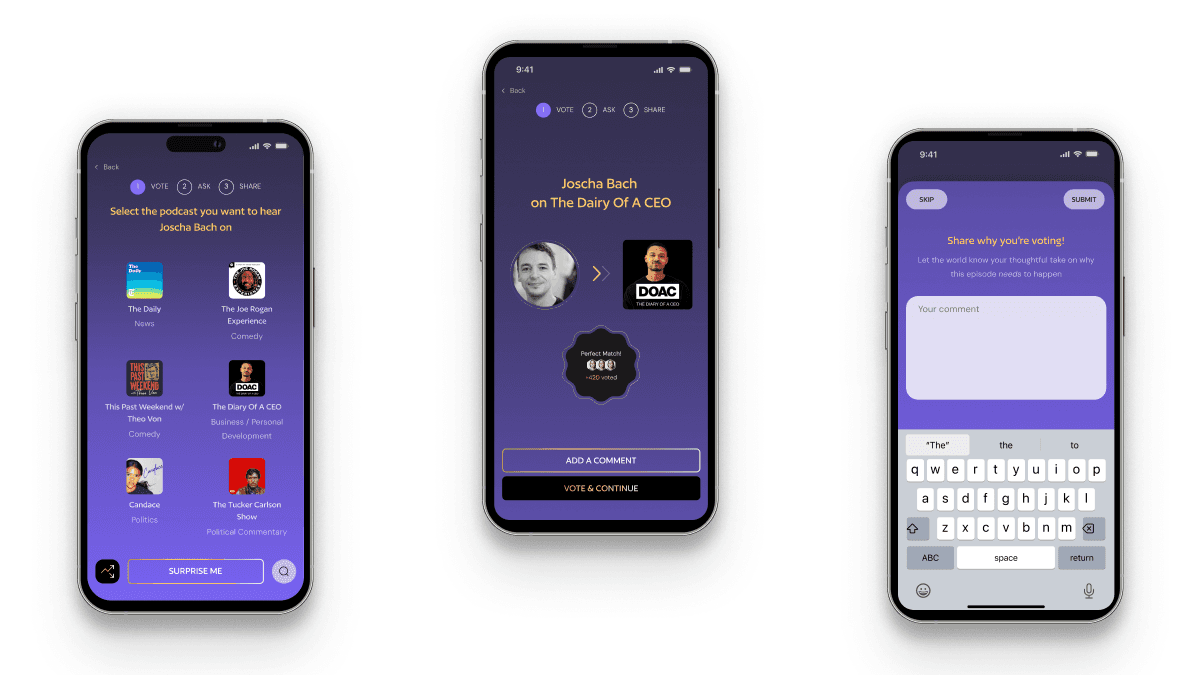
Questions moved the interaction beyond a popularity signal. The summary made the future conversation more tangible and shareable, helping users see that their actions were contributing to something larger than a single vote.
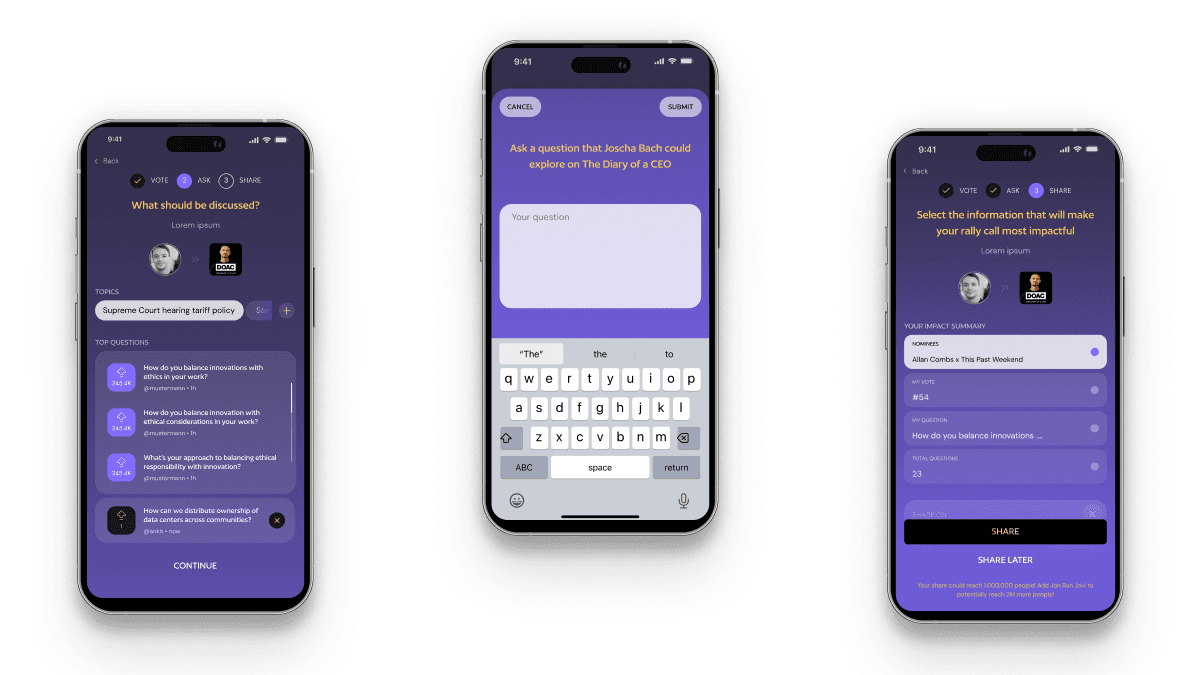
Voting gave listeners an understandable first action, without asking them to grasp a new category before participating.
Each decision needed to reinforce the conversation taking shape, not feel like another disconnected step.
People could begin lightly and decide whether to move toward a question, a proposal, or sharing it with others.
Onboarding, the Episode Builder, website messaging, and GTM all needed to express the same participation model.
The relevant pieces of the design system supported a clear sequence: recognizable choices, visible progress, consistent action states, and prompts that stayed direct and conversational.
Dark surfaces establish focus, while violet and gold clarify selection and action.
Compact utility labels support prompts that remain conversational and easy to scan.
I began treating GTM as another layer of the participation experience. Podcast Champions used familiar actions to bring communities in, while positioning the broader value around audience insight, community activation, and shaping future conversations.
Helped shape Podcast Champions with the founders around a simple idea: give podcast communities something they could champion together.
Built messaging and outreach that used nominations and voting as familiar entry points while leading with audience insight and community activation.
Translated the campaign into reusable formats, social assets, host materials, and language that could adapt across podcast communities.
Created workflows for identifying, organizing, and managing prospective podcast partners so the campaign could move from concept into practice.
The campaign concept was shaped collaboratively with the founders. I owned much of its execution from strategy to system: partner outreach, messaging, repeatable content formats, campaign assets, and the workflows used to identify and manage podcast partners.
Give listeners a concrete conversation to rally around.
Move from support toward questions and audience insight.
Give hosts and communities repeatable ways to carry the idea forward.
We did not have enough analytics to quantify improved comprehension. The honest early signal was consistency: the same participation model began helping the team connect product decisions with the way dLogos was explained externally. This work was shaped through regular product and GTM syncs, working sessions, team stands, and rapid asynchronous reviews—not a linear handoff from strategy to design.